Let’s explore how portable inverter generators convert raw mechanical energy into stable, clean electricity. By combining advanced engine mechanics with sophisticated electronic circuits, these devices optimize power output and fuel efficiency while minimizing emissions. Understanding the precise steps—from combustion to power regulation—reveals why inverter technology outperforms conventional generators. But before we examine the intricate conversion process, it’s essential to distinguish what sets portable inverter generators apart in design and function.
Key Takeaways
- Portable inverter generators convert engine power into consistent AC electricity using electronic circuitry, producing a clean, near-sinusoidal waveform.
- They adjust engine speed based on load demand, improving fuel efficiency and reducing noise during operation.
- Combustion drives a piston that rotates the generator rotor, inducing fluctuating raw AC power in stator coils.
- A rectifier converts raw AC to DC, then high-speed switches invert DC back to stable AC with fixed frequency and voltage.
- Inverter technology minimizes harmonic distortion below 3%, ensuring safe, stable power for sensitive electronics.
What Is a Portable Inverter Generator and How Does It Differ?
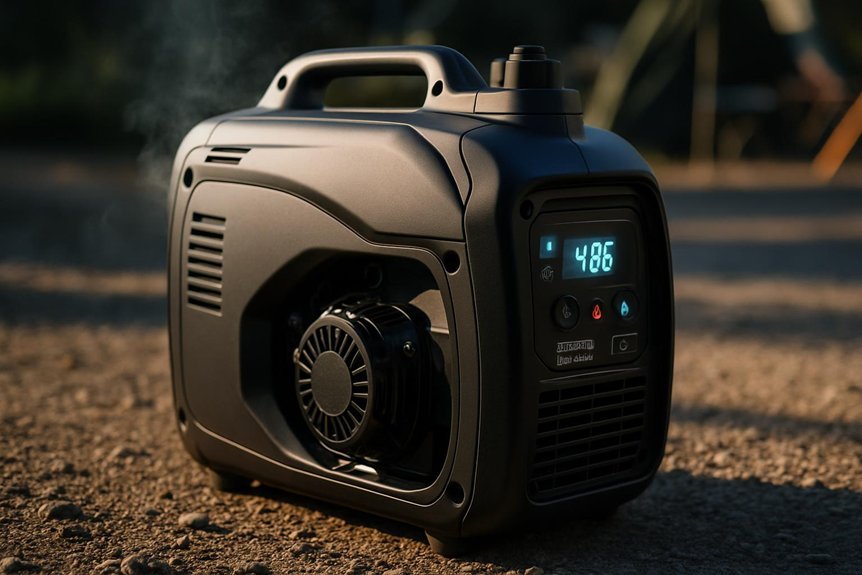
A portable inverter generator is a compact power source designed to deliver stable, clean electricity by converting raw engine power into consistent AC current through advanced electronic circuitry. Unlike conventional generators, which produce raw AC power directly from the engine, inverter generators refine this output to a near-sinusoidal waveform, ensuring minimal harmonic distortion. This process results in high-quality portable power suitable for sensitive electronics. The inverter benefits extend beyond power purity; these generators adapt engine speed to load demands, enhancing fuel efficiency and reducing noise. Their lightweight, compact design further distinguishes them, making them ideal for mobile applications. By integrating these technological advancements, portable inverter generators offer a versatile, reliable energy solution, setting them apart from traditional models in both performance and operational flexibility.
How the Engine Creates Power in an Inverter Generator
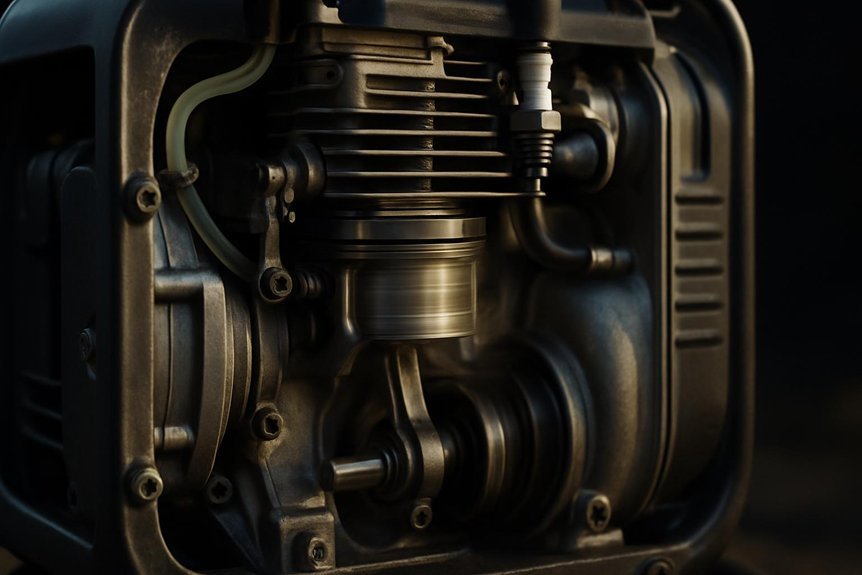
Understanding how the engine creates power in an inverter generator requires examining the combustion and mechanical processes at its core. The engine mechanics involve a controlled combustion cycle where fuel ignites in the cylinder, producing expanding gases that drive the piston. This linear motion converts to rotational motion via the crankshaft, which then powers the generator’s rotor. The rotor’s movement within the stator coils induces electrical current, initiating power generation. The engine’s precise timing and fuel delivery optimize efficiency and maintain consistent rotational speed, essential for stable electrical output. By mastering these engine mechanics, the inverter generator effectively converts chemical energy into mechanical energy, then into electrical energy, forming the foundation for reliable power generation in portable applications.
Why Inverter Technology Produces Cleaner Electricity
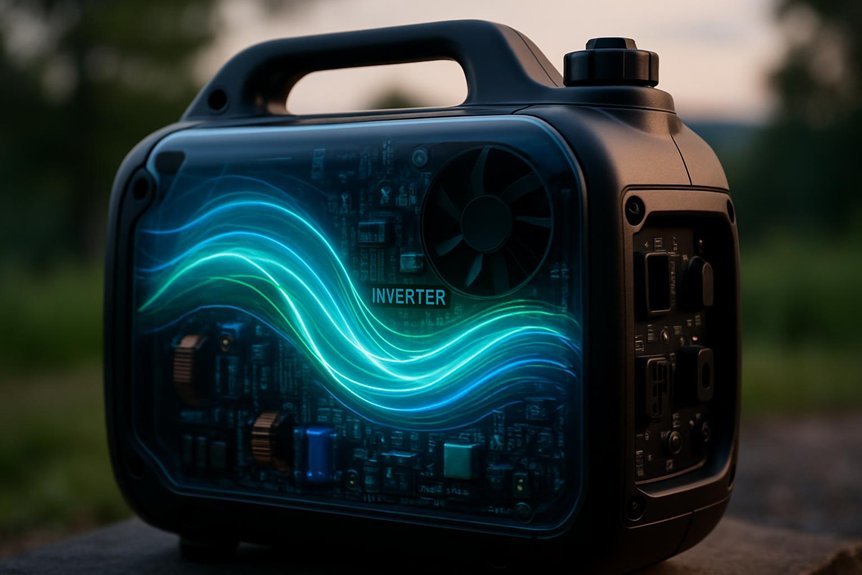
Because inverter technology continuously adjusts electrical output, it produces cleaner electricity compared to conventional generators. This precise modulation maintains a consistent frequency and voltage, minimizing harmonic distortion and electrical noise. As a result, inverter generators deliver stable, high-quality clean energy, essential for sensitive electronics. Unlike traditional generators that run at a constant speed regardless of load, inverter generators adjust engine speed to match demand, improving fuel efficiency and reducing harmful emissions. This dynamic control contributes to their eco-friendly profile by lowering pollutants and noise levels. By optimizing combustion and electrical output in real time, inverter technology guarantees power quality that supports both performance and environmental responsibility. Therefore, inverter generators represent a significant advancement in generating cleaner, more sustainable energy.
How the Inverter Converts Raw Power Into Stable Electricity
While raw power generated by the engine fluctuates in frequency and voltage, the inverter actively converts this unstable output into a consistent, clean electrical current. It begins by transforming the raw AC power into DC through a rectifier, eliminating irregularities caused by engine speed variations. Next, the inverter uses high-speed switching devices to convert this DC back into AC with a precise, fixed frequency and voltage. This power conversion process is essential for achieving energy stability, ensuring that the output meets strict electrical standards. By controlling the timing and waveform of the output voltage electronically, the inverter maintains a stable sine wave, suitable for sensitive electronics. This method allows portable inverter generators to deliver reliable, high-quality power despite the inherently variable nature of the initial engine output.
The Role of Electronic Circuitry in Power Regulation
Let’s examine how electronic circuitry guarantees consistent power output through voltage stabilization techniques and key inverter components. We’ll analyze how these circuits regulate frequency to maintain reliable performance under varying loads. Understanding these elements is essential for grasping the power regulation capabilities of portable inverter generators.
Voltage Stabilization Techniques
Although inverter generators produce cleaner power than conventional models, they still require sophisticated voltage stabilization techniques to guarantee consistent output. We rely on advanced voltage regulation methods, such as pulse-width modulation (PWM) and feedback control loops, to precisely adjust the generator’s output voltage in real-time. These techniques mitigate the effects of load variations and transient disturbances, ensuring stable power delivery. Additionally, power fluctuation solutions like dynamic compensation circuits help maintain voltage within tight tolerances, protecting sensitive electronics from damage. By continuously monitoring output parameters and adapting electrical signals accordingly, the generator’s electronic circuitry effectively stabilizes voltage. This precise control is essential for maintaining consistent performance, especially in environments with fluctuating loads or variable generator speeds, reinforcing the reliability of inverter generators in diverse applications.
Inverter Circuit Components
Electronic circuitry forms the backbone of power regulation within inverter generators, enabling precise control over the conversion and stabilization processes. The inverter circuit primarily consists of components such as microcontrollers, MOSFETs or IGBTs, transformers, and capacitors, each serving specific functions critical to performance. Microcontrollers regulate switching patterns to optimize waveform output, while MOSFETs act as high-speed switches, converting DC to AC efficiently. Transformers adjust voltage levels, ensuring compatibility with output requirements. Capacitors filter voltage ripples, smoothing the waveform to maintain stability. Together, these component functions coordinate to produce clean, stable power despite load variations. By integrating these elements within the inverter circuit, portable inverter generators achieve superior voltage regulation and reduced harmonic distortion, essential for sensitive electronics and consistent operation.
Frequency Regulation Methods
When we examine frequency regulation methods in portable inverter generators, we find that electronic circuitry plays a pivotal role in maintaining stable output frequency despite varying load conditions. These generators employ advanced frequency modulation techniques to dynamically adjust the switching frequency of the inverter’s transistors, ensuring consistent power delivery. By continuously monitoring load variations through sensors, the control circuitry modulates pulse widths and switching intervals, thereby compensating for frequency deviations. This precise modulation is essential for power quality assurance, preventing harmonic distortion and voltage fluctuations that can damage sensitive electronics. Ultimately, the integration of real-time electronic feedback loops enables inverter generators to maintain a steady 60 Hz output, regardless of load changes, which distinguishes them from conventional generators and enhances their reliability in diverse applications.
Why Portable Inverter Generators Are Ideal for Sensitive Devices
We rely on portable inverter generators because they provide clean power output with minimal harmonic distortion, which protects sensitive electronics from damage. Their ability to maintain a stable voltage supply guarantees consistent performance without fluctuations that could disrupt device operation. Let’s examine how these features make inverter generators the ideal choice for powering delicate equipment.
Clean Power Output
Although many generators produce power with fluctuations that can damage delicate equipment, portable inverter generators deliver a stable, clean power output that meets strict electrical standards. This clean energy is essential for operating sensitive devices without risk of damage or data loss. Their advanced electronic circuitry guarantees a pure sine wave output, minimizing harmonic distortion and electrical noise. Additionally, these generators are eco-friendly, maximizing fuel consumption and reducing emissions while maintaining consistent power quality.
Key benefits include:
- Precise voltage regulation for peak device performance
- Reduced total harmonic distortion (THD) below 3%
- Enhanced compatibility with sensitive electronics like laptops and medical devices
Stable Voltage Supply
A stable voltage supply is critical for protecting sensitive devices from damage caused by power fluctuations. Portable inverter generators excel in maintaining energy stability by continuously monitoring and adjusting the output voltage. Unlike conventional generators, they use advanced electronic circuits to regulate voltage precisely, minimizing voltage fluctuations that can harm delicate electronics. This regulation guarantees a consistent frequency and amplitude, which is essential for devices like laptops, medical equipment, and smartphones. By converting raw power into clean, stable electricity, inverter generators prevent surges and drops that could corrupt data or degrade hardware over time. When we rely on portable inverter generators, we can confidently power sensitive devices without risking malfunctions or damage from unstable energy sources, ensuring peak performance and longevity.
How Portability and Design Affect Generator Performance
Portability and design play essential roles in determining the overall performance of inverter generators. The design impact directly influences cooling efficiency, noise reduction, and component durability, which are critical for reliable operation. At the same time, portability benefits guarantee ease of transport and quick deployment without compromising power output or stability. We must consider these factors carefully to optimize generator functionality.
Key aspects include:
- Compact chassis design: Enhances maneuverability while maintaining structural integrity.
- Integrated handle systems: Facilitate transport, reducing setup time and physical strain.
- Optimized internal layout: Improves airflow and minimizes vibration, boosting operational efficiency.
How Fuel Efficiency Works in Portable Inverter Generators
Beyond design and portability, fuel efficiency greatly impacts the overall effectiveness and operational cost of portable inverter generators. To understand this, we analyze how different fuel types—primarily gasoline, propane, and diesel—affect performance. Each fuel type has distinct energy content and combustion characteristics, influencing efficiency ratings. For instance, propane typically burns cleaner but may deliver lower energy density, affecting runtime. Efficiency ratings measure how effectively a generator converts fuel into usable electrical power, often expressed in fuel consumption per hour at specific loads. Portable inverter generators optimize fuel efficiency through variable engine speeds, adjusting output to match demand rather than running at a constant rate. This adaptive approach reduces fuel wastage, improving overall consumption metrics. By evaluating fuel types alongside efficiency ratings, we can better predict operational costs and environmental impact.
Common Uses and Advantages of Portable Inverter Generators
We rely on portable inverter generators to provide stable power for outdoor activities, ensuring our devices run smoothly without interruption. Their energy efficiency reduces fuel consumption, which extends run time and lowers operational costs. Additionally, their quiet operation minimizes noise pollution, making them ideal for use in noise-sensitive environments.
Outdoor Activities Power
Anyone who enjoys outdoor activities knows how essential reliable power sources can be. Portable inverter generators provide consistent, clean electricity, making them indispensable for camping essentials and tailgating power. Their compact design and quiet operation allow us to power sensitive electronics and appliances without disruption. We rely on these generators to maintain efficiency and safety in remote environments.
Key applications include:
- Powering LED lighting, portable refrigerators, and communication devices during camping trips
- Supplying audio equipment and cooking appliances at tailgating events
- Charging batteries for drones, cameras, and GPS units in outdoor expeditions
Energy Efficiency Benefits
Building on their role in outdoor activities, portable inverter generators excel in energy efficiency, offering significant advantages over traditional generators. Their ability to modulate engine speed based on load demand results in peak fuel consumption, directly contributing to energy savings. Unlike conventional generators that run at a constant rate regardless of power need, inverter models adjust dynamically, reducing unnecessary fuel use. This efficiency translates to lower emissions, making these generators more eco friendly. Additionally, their advanced electronics guarantee cleaner power output, protecting sensitive devices from voltage fluctuations while maintaining efficiency. By minimizing fuel waste and emissions, portable inverter generators serve as a sustainable power solution for various applications, from camping to emergency backup, aligning performance with environmental responsibility.
Quiet Operation Advantages
Although portable inverter generators deliver impressive power efficiency, their quiet operation truly sets them apart in both residential and recreational settings. The silent operation results from advanced noise reduction technologies, including sound-dampening enclosures and optimized engine speed control. This minimizes acoustic disturbance without compromising performance.
We benefit from this quietness in scenarios where noise pollution can be problematic:
- Camping and outdoor activities, allowing a peaceful environment
- Residential backup power, preventing disruption to neighbors
- Worksites in noise-sensitive areas, maintaining compliance with local regulations
What to Look for When Choosing a Portable Inverter Generator
When we choose a portable inverter generator, we need to prioritize factors like power output, fuel efficiency, and noise levels to guarantee it meets our specific needs. Evaluating power output is essential; we must verify the generator’s rated and surge wattage to confirm it can handle our devices without overloading. Noise levels are equally important, especially in residential or recreational settings—selecting models with decibel ratings below 60 dB helps maintain quiet operation. Fuel efficiency impacts runtime and operating costs, so generators with advanced engine technology or eco-modes provide longer use per fuel tank. Additionally, we should consider portability features such as weight and handle design. By analyzing these technical specifications carefully, we assure our choice aligns with performance requirements and operational convenience.
Frequently Asked Questions
How Noisy Are Portable Inverter Generators During Operation?
We find portable inverter generators produce relatively low noise levels, typically between 40-60 decibels. With advanced soundproofing options, they minimize disruption, making them ideal for noise-sensitive environments without sacrificing performance or efficiency.
What Maintenance Is Required for Portable Inverter Generators?
We can’t overlook regular engine oil changes and fuel efficiency checks—they’re essential. Monitoring fuel quality, cleaning air filters, and inspecting spark plugs keep performance ideal. Proper maintenance guarantees reliability and longevity for your portable inverter generator.
Can Portable Inverter Generators Run Multiple Devices Simultaneously?
Yes, we can run multiple devices simultaneously with portable inverter generators by carefully managing power management and respecting the load capacity. This guarantees stable output and prevents overload, maintaining efficiency and protecting connected equipment.
Are Portable Inverter Generators Safe to Use Indoors?
We don’t recommend using portable inverter generators indoors due to carbon monoxide risks. For indoor safety, guarantee proper ventilation and use carbon monoxide detectors to prevent dangerous accumulation and protect everyone in the space effectively.
How Long Do Portable Inverter Generators Typically Last?
Imagine a family relying on their inverter generator during a week-long blackout. Typically, lifespan expectations range from 1,000 to 3,000 hours, influenced by durability factors like maintenance, usage intensity, and environmental conditions.
Conclusion
Just like a skilled conductor orchestrates a symphony, portable inverter generators harmonize engine power and advanced electronics to deliver clean, stable electricity. With up to 30% better fuel efficiency than conventional models, they adapt seamlessly to varying loads, minimizing waste and emissions. By understanding their inner workings, we can appreciate how these compact powerhouses blend precision engineering with portability, making them essential tools for reliable, efficient energy wherever we need it.