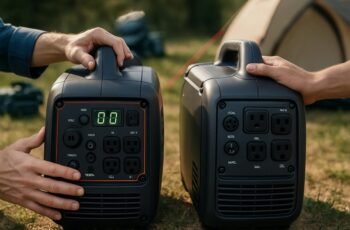
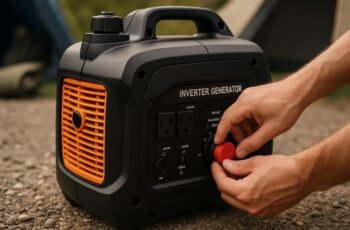
We often assume that any inverter generator will meet our power needs, but mismatching size can lead to inefficiency or damage. To avoid this, we need to analyze our devices’ total wattage demands, distinguishing running from starting watts with precision. Understanding these factors is essential, especially when balancing portability, fuel type, and cost. Let’s explore how to accurately size an inverter generator to guarantee reliable, efficient power tailored to your specific situation.
Key Takeaways
- Calculate total continuous and starting wattage of all devices to determine accurate power needs.
- Choose a generator with pure sine wave output for sensitive electronics and stable voltage.
- Include a 20-30% capacity buffer to accommodate power surges and load sensitivity.
- Match generator size to specific applications like camping or home backup for optimized performance.
- Consider fuel type, portability, noise level, and fuel efficiency when selecting a generator.
How to Calculate Your Power Needs for an Inverter Generator
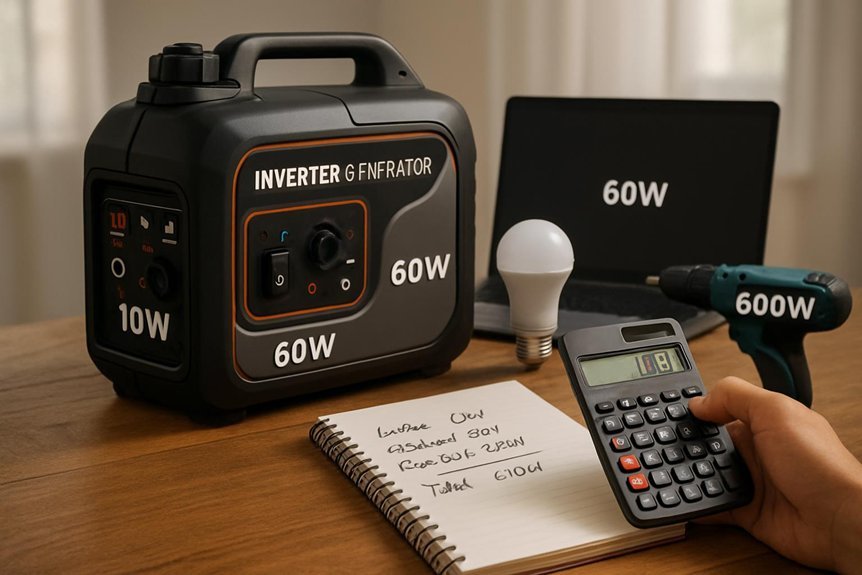
How do we accurately determine the power requirements for an inverter generator? First, we need to list all the electrical devices we plan to power simultaneously and note their power draw in watts. By summing these values, we establish the total wattage demand. It’s essential to take into account the continuous power draw rather than momentary spikes to guarantee stability. This method helps us select an inverter generator that meets our needs without oversizing, which can reduce energy efficiency. Choosing a generator closely matched to our calculated load maximizes fuel economy and minimizes unnecessary wear. Accurately evaluating power draw enables us to optimize the inverter generator’s performance, assuring reliable operation while maintaining high energy efficiency throughout its use.
Understanding Running vs. Starting Watts Explained

Why do we need to differentiate between running watts and starting watts when sizing an inverter generator? Running wattage represents the continuous power an appliance requires, while starting wattage accounts for the initial power surge during startup, also known as peak demand. Understanding this distinction is vital for accurate wattage calculation and guarantees appliance compatibility without overloading the generator.
| Parameter | Running Wattage (W) | Starting Wattage (W) |
|---|---|---|
| Refrigerator | 150 | 600 |
| Air Conditioner | 1000 | 3000 |
| Power Tools | 800 | 1200 |
Effective load management considers both wattages to optimize generator efficiency and prevent power surges that could damage appliances or compromise performance.
Choosing the Right Generator Size for Camping and Outdoor Use
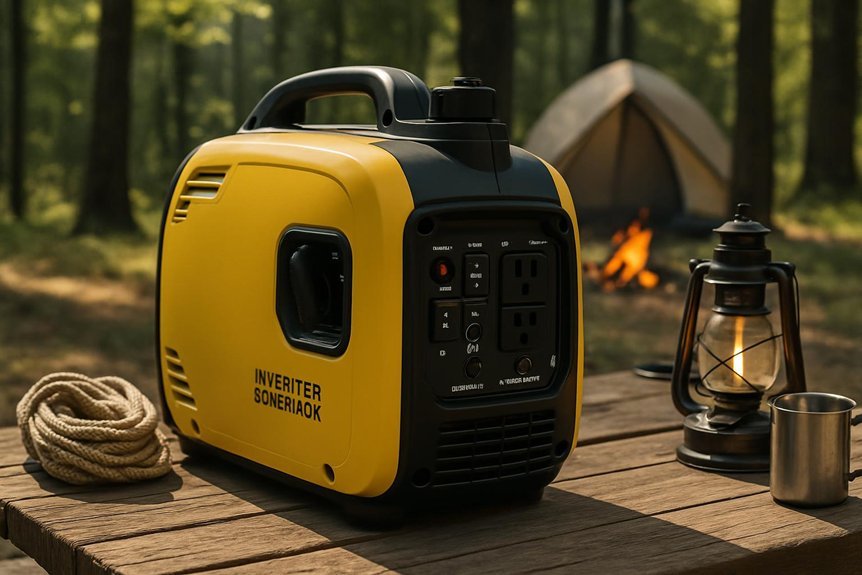
Now that we recognize the difference between running and starting watts, we can apply this knowledge to select the appropriate inverter generator size for camping and outdoor activities. First, we analyze the total power consumption of camping essentials—lights, small appliances, and chargers—to determine required wattage. Considering inverter types, pure sine wave models provide clean power for sensitive electronics. Noise levels are critical outdoors, so we prioritize quieter units verified by user reviews. Brand reliability influences long-term performance, so we evaluate warranty options and maintenance tips to promote durability. By balancing power needs with portability and noise constraints, we select an inverter generator that meets our camping demands efficiently without excess capacity, optimizing fuel use and minimizing weight. This analytical approach guarantees dependable power tailored for outdoor use.
Picking an Inverter Generator Size for Home Backup Power
When selecting an inverter generator size for home backup power, we must carefully assess the essential circuits and appliances that require uninterrupted electricity during outages. Calculating the combined wattage of critical loads—such as refrigerators, sump pumps, and medical devices—helps us determine the minimum power output needed. Prioritizing power efficiency guarantees we choose a generator that delivers sufficient energy without unnecessary fuel consumption. Additionally, noise reduction is vital for residential settings; opting for models with advanced inverter technology minimizes sound levels while maintaining stable power output. By balancing these factors, we can select a generator size that provides reliable, quiet backup power tailored to our home’s specific demands, avoiding oversizing that wastes resources or undersizing that risks inadequate performance during emergencies.
How Fuel Type and Runtime Affect Generator Sizing
Although selecting the right inverter generator size hinges on power requirements, understanding how fuel type and runtime influence generator performance is equally critical. Different fuels—gasoline, propane, diesel—vary in energy density, directly affecting fuel efficiency and runtime. For instance, propane offers cleaner combustion with lower environmental impact but typically delivers shorter runtime per tank compared to gasoline. Diesel boasts superior fuel efficiency and longer runtime, though it may produce higher emissions unless equipped with advanced controls. When sizing, we must factor in these trade-offs to guarantee continuous operation without excessive refueling. Longer runtimes demand larger fuel capacity or more efficient fuel use, impacting generator size and design. Prioritizing fuel efficiency and environmental impact allows us to select an inverter generator that balances operational endurance with sustainability goals.
Why Portability and Weight Matter When Sizing Your Generator
When sizing your inverter generator, we need to take into account portability and weight because they directly affect ease of transportation and overall mobility. A heavier unit can limit where and how often you can move it, especially in outdoor settings. Balancing power output with manageable weight guarantees the generator meets both performance and practical use requirements.
Ease of Transportation
Three key factors define the ease of transportation for inverter generators: weight, dimensions, and design features like handles or wheels. A compact design enhances ease of use, allowing us to maneuver the unit efficiently in diverse environments. When sizing your generator, consider these attributes as they directly influence portability without compromising performance.
| Feature | Impact on Portability | Example |
|---|---|---|
| Weight | Heavier units reduce ease | 45 lbs vs. 85 lbs |
| Dimensions | Bulkier units hinder access | 20″x15″x17″ vs. 28″x20″x22″ |
| Handles/Wheels | Facilitates movement | Integrated wheels and ergonomic handles |
Weight Impact on Mobility
Because weight directly affects how easily we can move and position an inverter generator, it plays a critical role in sizing decisions. When evaluating mobility factors, we must consider both the total weight and how that weight is distributed within the unit. Uneven weight distribution can create balance challenges, making the generator harder to lift or maneuver despite a manageable overall mass. Additionally, concentrated weight points may increase strain during handling and transport. By analyzing these variables, we guarantee that the selected generator aligns with our mobility requirements, minimizing physical effort and reducing injury risk. Optimizing weight distribution alongside total weight helps us maintain control and stability during movement, ultimately improving operational efficiency and safety in deployment scenarios where quick repositioning is necessary.
Portability for Outdoor Use
Balancing weight and distribution sets the foundation for understanding portability in outdoor environments. When sizing an inverter generator, we must prioritize a lightweight design to facilitate ease of transport across uneven terrain. Portability hinges not only on weight but also on how durable materials contribute to the generator’s resilience during frequent movement and exposure to environmental stressors. Durable materials guarantee the unit withstands impacts and weather without compromising functionality. Additionally, ergonomic considerations, such as well-placed handles and compact dimensions, optimize user handling. By integrating lightweight design with robust construction, we achieve a generator that is both easy to carry and reliable under outdoor conditions. This balance directly influences our ability to deploy power efficiently in remote or mobile scenarios, making portability a critical sizing factor.
Matching Generator Size to Your Budget Without Overspending
When selecting an inverter generator, we must balance the required power output with our budget constraints to avoid overspending. Focusing on essential features guarantees we get the best performance without paying for unnecessary capabilities. Let’s analyze how to prioritize specifications that maximize value while meeting our power needs.
Balancing Power And Cost
Several factors influence the ideal inverter generator size for your needs, and cost is a major consideration we can’t overlook. To balance power and cost effectively, we must conduct a thorough cost analysis, weighing upfront expenses against long-term power efficiency. Oversizing a generator drives up initial costs and fuel consumption, reducing overall efficiency. Conversely, undersizing risks insufficient power supply, causing operational issues. By calculating your essential power requirements precisely, we can select a generator that meets demand without excess capacity, optimizing both cost and performance. Prioritizing units with high power efficiency ratings guarantees lower fuel costs and longer runtime, which contributes to better value over time. This analytical approach helps us avoid overspending while securing reliable power tailored to your specific applications.
Prioritizing Essential Features
After determining the appropriate generator size to meet your power needs without overspending, the next step is to focus on the features that directly impact performance and cost-effectiveness. Prioritizing essential specifications like fuel efficiency, noise level, and runtime guarantees you select a model that maximizes feature benefits within your budget. For instance, an inverter generator with advanced throttle control can reduce fuel consumption, while low-decibel operation enhances usability in noise-sensitive environments. Additionally, consider essential specs such as parallel capability and multiple outlets, which increase versatility without greatly raising costs. By analytically weighing these feature benefits against your budget constraints, we can avoid overspending on non-critical functions while guaranteeing reliable, efficient power. This targeted approach assures an ideal balance between performance and affordability.
Tips for Sizing an Inverter Generator for Sensitive Electronics
How do we guarantee our inverter generator provides stable power for sensitive electronics without risking damage? Understanding load sensitivity and ensuring equipment compatibility are essential. Sensitive devices demand clean, consistent power with minimal harmonic distortion. To size correctly:
Ensuring stable, clean power from your inverter generator is key to protecting sensitive electronics.
- Calculate total wattage including startup surges
- Choose a generator with pure sine wave output
- Factor in a 20-30% capacity buffer for load sensitivity
- Verify voltage and frequency stability under varying loads
- Match generator specs precisely to your equipment’s power requirements
Frequently Asked Questions
How Often Should I Perform Maintenance on My Inverter Generator?
We should perform maintenance on our inverter generator every 50 hours or annually, focusing on oil changes and filter replacements. Regular checks guarantee peak performance, prevent damage, and extend the generator’s lifespan effectively.
Can Inverter Generators Be Used Safely Indoors?
We can’t use inverter generators indoors safely due to carbon monoxide risks. Ensuring indoor safety requires proper ventilation and carbon monoxide detectors, but running generators inside still poses serious health hazards we must avoid at all costs.
What Noise Levels Can I Expect From Different Inverter Generator Sizes?
We’ve found noise comparison shows smaller inverter generators emit around 50 decibels, while larger models reach 65 decibels. Size impact directly correlates with noise levels, so choosing the right size balances power needs and sound output.
Are Inverter Generators Compatible With Solar Power Systems?
Yes, inverter generators offer solar compatibility due to their inverter efficiency, allowing seamless integration with solar power systems. This guarantees stable, clean power output essential for charging batteries and powering solar-dependent devices reliably.
How Do Weather Conditions Affect Inverter Generator Performance?
It is understood that temperature impact reduces efficiency, while humidity effects can cause corrosion. Altitude considerations lower power output due to thinner air. Seasonal performance varies, so we must adjust usage based on these environmental factors to optimize reliability.
Conclusion
In choosing the right inverter generator, we can’t afford to guess—it’s like trying to power a city with a flashlight. By accurately calculating running and starting watts, considering fuel and portability, and aligning with your budget, we guarantee efficiency and reliability. Whether for camping or home backup, matching your generator size to your unique needs ensures peak performance without overspending. Let’s power smartly, keeping sensitive electronics safe and your energy demands met precisely.