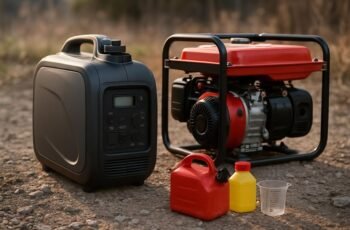
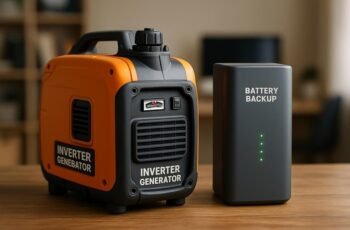
Picture choosing between a reliable old car that needs regular fuel stops and a sleek electric vehicle with a higher upfront price but lower running costs. When it comes to powering our homes during outages, inverter generators and home battery backups present a similar trade-off in cost, performance, and long-term value. Understanding these differences can help us make a more informed choice—so let’s explore how each option stacks up in real-world use.
Key Takeaways
- Inverter generators have lower upfront costs but incur ongoing fuel and maintenance expenses, unlike home battery backups with higher initial investment and minimal operating costs.
- Battery backups provide silent, emission-free power with stable voltage, while inverter generators produce noticeable noise and emit pollutants.
- Inverter generators offer continuous power as long as fuel is available, whereas battery backups depend on stored charge and require recharging after use.
- Maintenance for inverter generators is regular and hands-on, whereas battery systems mainly need software updates and battery health monitoring.
- Over time, home battery backups often yield better ROI due to energy efficiency, lower operating costs, and potential incentives compared to inverter generators.
How Inverter Generators and Home Battery Backups Work
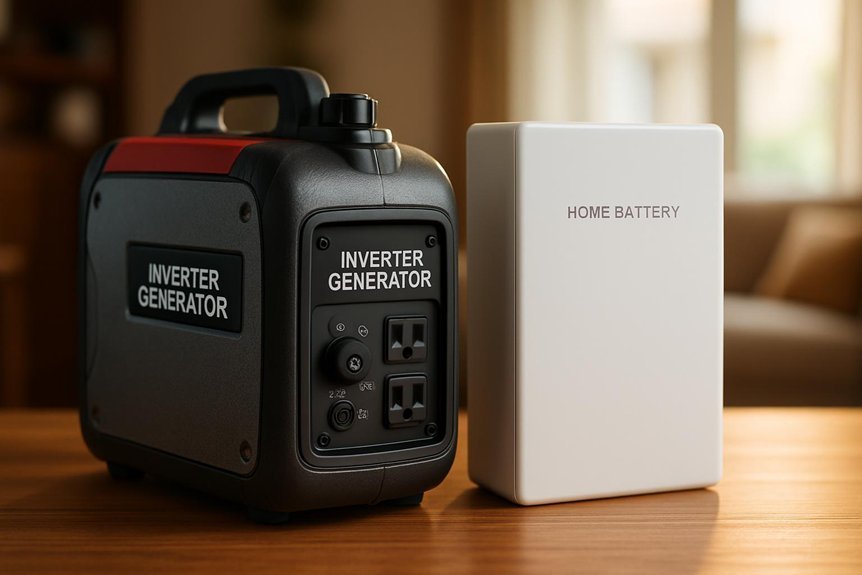
Although inverter generators and home battery backups serve the same primary purpose of providing power during outages, they operate through fundamentally different mechanisms. Inverter mechanics rely on a fuel-powered engine that drives an alternator, generating alternating current (AC). This AC is then converted into direct current (DC) and back to a stable, clean AC output, ensuring consistent voltage and frequency. Conversely, home battery backups depend on advanced battery technology, typically lithium-ion cells, to store electrical energy. When an outage occurs, the stored DC power is inverted to AC for household use. While inverter generators continuously produce power through combustion, battery backups deliver stored energy silently and without emissions. Understanding these operational differences helps us evaluate their suitability based on energy needs, runtime, and environmental impact.
Comparing Initial Costs and Long-Term Expenses
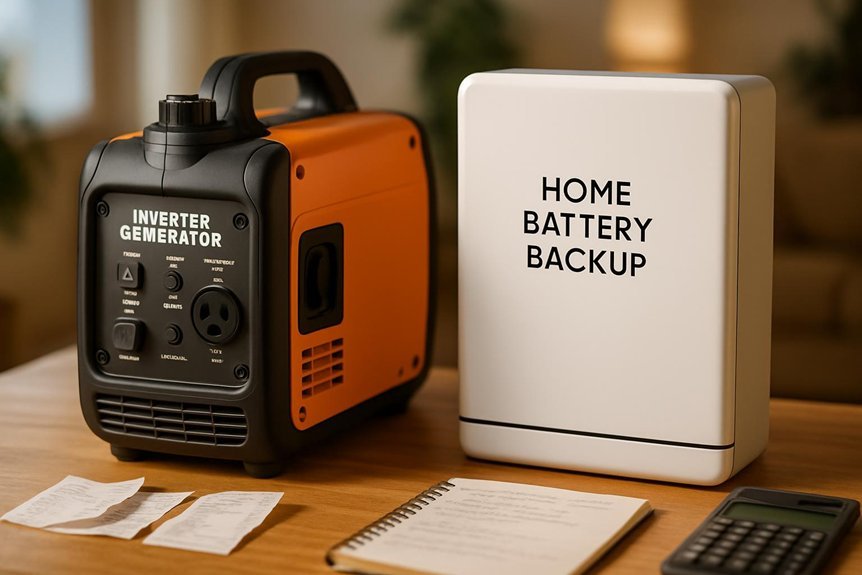
Let’s start by examining the upfront purchase price of inverter generators versus home battery backups. We’ll also consider ongoing maintenance and operating costs to understand their true long-term financial impact. This comparison will help us identify which option offers better value over time.
Upfront Purchase Price
When comparing inverter generators and home battery backups, we need to carefully examine their upfront purchase prices as well as the long-term expenses they entail. Inverter generators typically have lower initial costs, often ranging from a few hundred to a couple thousand dollars depending on power output. Home battery backups, however, involve significant purchase considerations due to higher price variations influenced by battery capacity, brand, and technology. These systems can start around several thousand dollars and escalate quickly with added features or larger storage. Understanding these price variations helps us evaluate which option fits our budget and power needs better. While inverter generators offer a more accessible entry point, home battery backups represent a larger upfront investment, demanding thorough financial assessment before deciding on the best solution for reliable home power backup.
Maintenance and Operating Costs
Because upfront costs only tell part of the story, we need to closely examine maintenance and operating expenses to understand the true long-term financial impact of inverter generators and home battery backups. Inverter generators require regular maintenance—oil changes, air filter replacements, and spark plug checks—to sustain operating efficiency. Neglecting these maintenance tips can lead to costly repairs and reduced lifespan. Conversely, home battery backups demand less routine upkeep but may require occasional software updates and battery health monitoring. Operating costs differ too: generators rely on fuel, creating ongoing expenses, while batteries draw electricity, often at a lower cost depending on local rates. By factoring in these maintenance and operating considerations, we gain a clearer picture of which system delivers better value over time and aligns with our budget and energy needs.
Fuel and Charging: What Powers Each System?
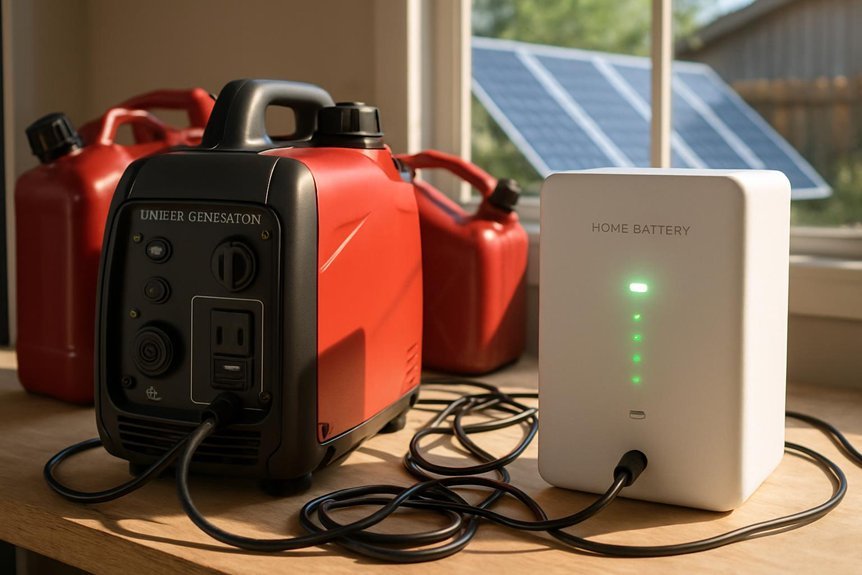
Although both inverter generators and home battery backups provide essential power during outages, they rely on fundamentally different sources for fuel and charging. Inverter generators primarily use fuel types like gasoline, propane, or diesel, which are combusted to generate electricity on demand. This direct fuel consumption offers continuous power as long as fuel is available, but requires fuel storage and careful handling. Conversely, home battery backups store electrical energy, which is replenished through charging methods such as grid power, solar panels, or other renewable sources. Charging time depends on the battery capacity and input source, often taking several hours to reach full charge. Understanding these fuel types and charging methods is vital when evaluating reliability, convenience, and long-term costs, as they directly affect system availability and operational expenses during power disruptions.
Noise Levels and Environmental Impact Differences
Let’s compare the noise emissions of inverter generators and home battery backups, as this impacts both comfort and community. We’ll also examine their emission levels, focusing on pollution and environmental consequences. Understanding these factors helps us choose more eco-friendly energy solutions for our homes.
Noise Emission Comparison
When comparing noise emissions, inverter generators and home battery backups reveal distinct differences that impact both our comfort and the environment. Inverter generators produce mechanical noise due to their combustion engines, typically ranging from 40 to 60 decibels. While they often include noise reduction features, their sound output can still be noticeable, especially in quiet residential areas. Soundproofing options like insulated enclosures can mitigate noise but add to overall costs and maintenance. In contrast, home battery backups operate silently since they rely on stored electrical energy without moving parts or combustion. This silent operation offers a significant advantage for noise-sensitive environments and reduces noise pollution. Consequently, from a noise emission perspective, home battery backups clearly provide superior comfort and minimal environmental disturbance compared to inverter generators.
Emission and Pollution Levels
Beyond noise levels, we must consider the broader emission and pollution impacts of inverter generators and home battery backups. Inverter generators rely on combustion engines, which emit pollutants regulated by strict emission standards. Despite improvements, these units still produce nitrogen oxides and particulate matter, contributing to air pollution. In contrast, home battery backups generate no on-site emissions during operation, offering significant pollution reduction benefits. Key differences include:
- Inverter generators emit greenhouse gases and require fuel, impacting air quality.
- Home battery backups store clean energy, reducing reliance on fossil fuels.
- Emission standards limit inverter generator pollutants, but do not eliminate them.
Understanding these distinctions helps us weigh environmental impact alongside performance and cost when choosing between these backup power options.
Eco-Friendly Energy Solutions
Although both inverter generators and home battery backups provide essential power solutions, their differences in noise levels and environmental impact make them distinct choices for eco-conscious users. Inverter generators, while quieter than conventional generators, still emit noticeable noise and rely on fuel combustion, which can disrupt neighborhoods and contribute to pollution. Conversely, home battery backups operate silently, drawing stored energy often sourced from renewable systems, aligning better with sustainable practices. This silent operation supports energy independence without compromising tranquility. Additionally, battery backups reduce reliance on fossil fuels, minimizing carbon footprints. By choosing home battery backups, we embrace cleaner, quieter energy solutions that foster sustainable living. In contrast, inverter generators, though practical, fall short in noise reduction and environmental friendliness, making battery backups preferable for those prioritizing eco-friendly energy solutions.
Performance for Home Use: Power Output and Reliability
Power output and reliability form the core criteria we need to evaluate when comparing inverter generators and home battery backups for residential use. Both solutions have distinct strengths in power efficiency and load capacity, which directly impact their performance at home.
- Power Efficiency: Home battery backups typically offer higher efficiency by storing and delivering energy without fuel consumption, whereas inverter generators convert fuel to power, leading to energy loss.
- Load Capacity: Inverter generators can handle fluctuating loads better, supporting high-demand appliances temporarily, while battery backups provide steady power until depletion.
- Reliability: Battery systems depend on charge levels and may require recharging infrastructure, whereas inverter generators rely on fuel availability but can run continuously.
Understanding these factors helps us choose the right solution tailored to our home’s specific power needs and reliability expectations.
Calculating ROI: Which Option Saves More Over Time?
Now that we’ve examined how inverter generators and home battery backups perform regarding power output and reliability, it’s important to look at the financial implications of each option. Conducting a thorough ROI analysis reveals distinct differences in long term savings. Inverter generators typically require lower upfront costs but incur ongoing fuel and maintenance expenses, which can add up. Conversely, home battery backups demand higher initial investment but benefit from minimal operating costs and potential incentives, improving their long term savings. When calculating ROI, we must factor in lifespan, energy efficiency, and usage patterns. Over time, the battery backup often delivers a stronger return due to reduced fuel dependency and quieter operation. Ultimately, understanding these financial dynamics helps us determine which solution best balances cost and value for our specific needs.
Frequently Asked Questions
Can Inverter Generators and Home Batteries Be Used Together?
Yes, we can use inverter generators and home batteries together, but we must address compatibility concerns carefully. Doing so can improve backup efficiency, yet comparing performance helps us optimize overall energy management and reduce waste effectively.
What Maintenance Is Required for Each Backup System?
We understand inverter generators need regular fuel checks and oil changes to maintain fuel efficiency, while home batteries require minimal upkeep but monitoring lifespan comparison is essential to guarantee reliable performance over time.
Are There Any Safety Risks With Inverter Generators or Battery Backups?
We’ve seen a family nearly suffer carbon monoxide poisoning from poor ventilation with an inverter generator. Despite better fuel efficiency and noise levels, we must use them outdoors; battery backups avoid this risk indoors safely.
How Do Weather Conditions Affect Each Backup Option?
Weather impacts inverter generators by reducing efficiency in extreme cold or wet conditions, while battery backups face efficiency variations due to temperature affecting battery capacity. We need to contemplate these factors for reliable backup performance.
Can Either System Support Outdoor or Recreational Use?
Yes, both systems can provide portable power for outdoor adventures and recreational activities. Inverter generators are ideal camping essentials due to portability, while home battery backups suit extended outdoor use but are less convenient to transport.
Conclusion
When it comes to powering our homes, choosing between inverter generators and home battery backups feels like picking between night and day. Generators roar on with endless fuel, but those costs keep sneaking up like a shadow. Battery backups sit silently, saving us a fortune over time and sparing the planet with every watt. So, if we crave efficiency and long-term savings, the battery backup isn’t just a choice—it’s the future knocking at our door.