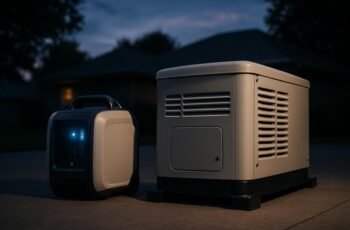
Picture a campsite where a portable power station quietly hums beside a roaring inverter generator. Both provide energy, but their charging speeds and output capabilities differ considerably. Understanding these differences helps us determine which device suits our needs, whether powering heavy tools or keeping small electronics alive. Let’s explore the technical factors driving their performance and uncover which option aligns best with various power demands.
Key Takeaways
- Inverter generators recharge fuel tanks within 1–2 hours, providing quicker refueling compared to portable power stations’ battery charging times.
- Portable power stations typically take 4–8 hours to charge via AC and over 10 hours with solar input depending on conditions.
- Inverter generators offer higher peak power capacity, suitable for starting heavy-duty equipment like tools and refrigerators.
- Portable power stations deliver stable continuous output with lower peak capacity, ideal for small electronics and sensitive devices.
- Charging speed and output depend on fuel combustion efficiency for generators and battery chemistry plus input power ratings for power stations.
How Inverter Generators and Portable Power Stations Work Differently
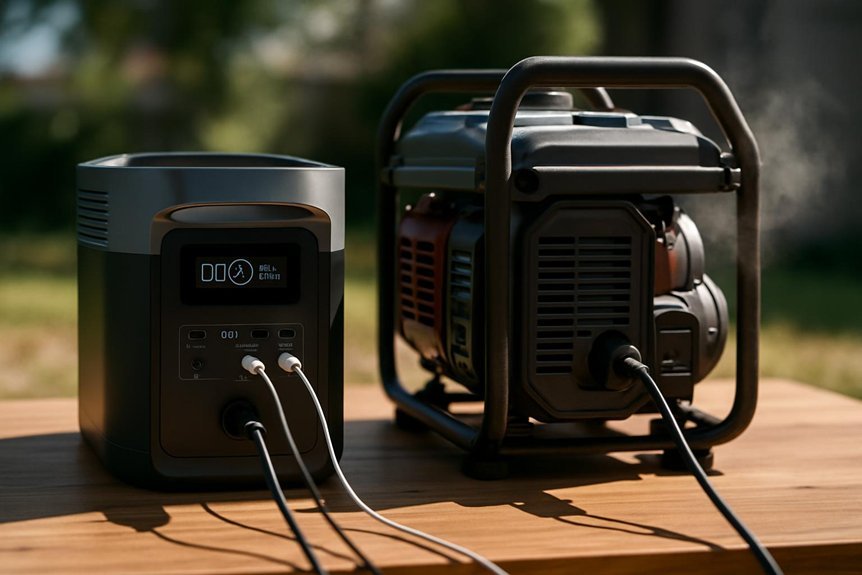
Although both inverter generators and portable power stations provide electrical power on the go, they operate on fundamentally different principles. Inverter generators rely on inverter mechanisms to convert mechanical energy from a combustion engine into stable, clean AC power. This technology modulates engine speed to optimize fuel efficiency and reduce noise, producing consistent sine wave output suitable for sensitive electronics. In contrast, power station technology centers on chemical energy stored in rechargeable batteries. These units use integrated inverters to convert DC battery power into AC electricity. Unlike generators, power stations operate silently and require external charging sources. Understanding these operational distinctions helps us evaluate their suitability for various applications, emphasizing the mechanical-electrical conversion in inverter generators versus the electrochemical-electrical process inherent in portable power stations.
What Affects Charging Speed in Inverter Generators vs Power Stations
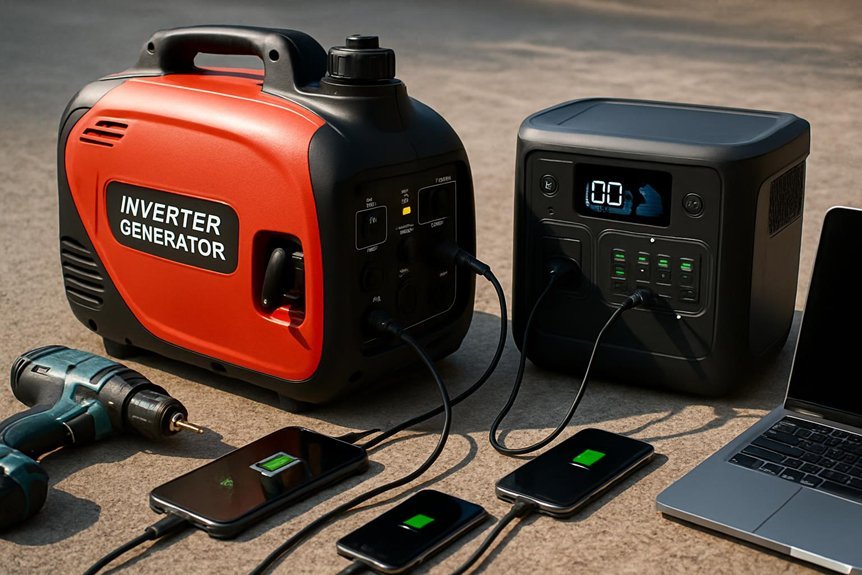
When comparing inverter generators and portable power stations, we must consider the factors that influence their charging speeds, as these directly impact their efficiency and usability in the field. Key charging factors include input power ratings, battery chemistry, and the design of the charging circuitry. Inverter generators rely on fuel combustion to generate electricity, so fuel type, engine efficiency, and load management affect their charging output. Portable power stations depend on lithium-ion or lithium iron phosphate batteries, where internal battery management systems regulate charge acceptance rates to optimize longevity and safety. Additionally, the presence of multiple input options (AC, solar, carport) and their respective power limits influence overall charging speed. Efficiency considerations also encompass energy conversion losses and thermal management, which can throttle charge rates to prevent overheating and extend device lifespan.
Comparing Typical Charging Times for Both Devices
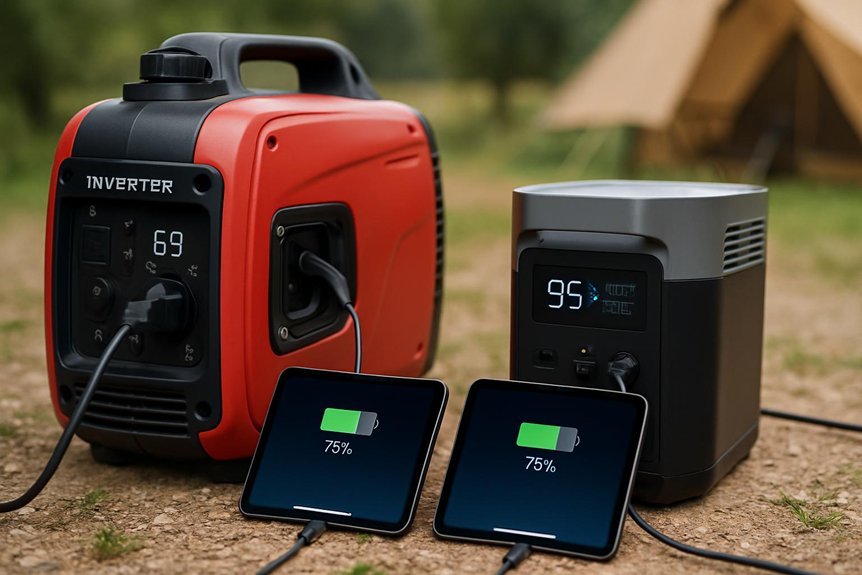
Since charging time directly affects how quickly we can deploy our equipment, understanding the typical durations for inverter generators and portable power stations is crucial. Inverter generators generally recharge fuel tanks within one to two hours, offering high charging efficiency due to their direct combustion-to-electricity process. Portable power stations, however, vary widely; charging times depend heavily on input wattage and device compatibility with solar panels, wall outlets, or car chargers. For example, a portable power station with 500Wh capacity might take 4 to 8 hours to fully charge via AC power, while solar charging can extend beyond 10 hours depending on conditions. Evaluating charging efficiency alongside compatibility guarantees we select the device that aligns best with our operational demands and minimizes downtime.
Power Output: What You Can Expect From Each Device
Let’s examine the peak power capacity and continuous power output of inverter generators and portable power stations to understand their performance limits. Inverter generators typically deliver higher peak power, making them suitable for heavy-duty applications. Portable power stations, while offering stable continuous output, generally have lower peak capacity, affecting the range of devices they can support simultaneously.
Peak Power Capacity
Power output defines the practical limits of both inverter generators and portable power stations, dictating what devices and appliances they can reliably support. Peak power capacity refers to the maximum instantaneous power a device can deliver, essential for starting high-demand equipment like power tools or refrigerators. Inverter generators often provide higher peak power, enabling them to handle surge currents from heavy-duty appliances better than many portable power stations. However, portable power stations are improving, with some models offering competitive peak power suitable for moderate usage scenarios, such as charging electronics or running small appliances. Understanding peak power helps us match the right device to specific tasks, ensuring reliable performance without overloading the system or risking damage to connected equipment.
Continuous Power Output
Although peak power capacity determines how well a device manages surges, continuous power output defines the steady energy supply you can rely on over time. When comparing inverter generators and portable power stations, continuous power is critical for effective energy management, especially during extended use.
Key points to evaluate include:
- Inverter generators generally provide higher continuous power outputs, suitable for running heavy-duty appliances consistently.
- Portable power stations offer stable but lower continuous power, optimized for small electronics and sensitive devices.
- Energy management in power stations involves battery capacity and inverter efficiency, impacting how long continuous power is sustained.
Understanding these factors helps us select the right device based on our continuous power needs, ensuring reliable and uninterrupted energy delivery for various applications.
How Load Type Influences Output and Charging Efficiency
When we compare resistive and inductive loads, we see distinct effects on output stability and charging speed in both inverter generators and portable power stations. Resistive loads tend to allow more consistent efficiency, while inductive loads can cause fluctuations that reduce charging performance. Understanding these differences helps us optimize how each device handles various electrical demands.
Resistive Versus Inductive Loads
Since different types of electrical loads interact uniquely with power sources, understanding resistive versus inductive loads is essential for evaluating output and charging efficiency. Resistive loads, like heaters and incandescent bulbs, draw current proportional to voltage, resulting in a straightforward power demand. Inductive loads, such as motors and transformers, create lagging power factors due to their magnetic fields, complicating power delivery.
Key distinctions include:
- Resistive loads maintain constant power draw, enhancing stable output.
- Inductive loads cause phase shifts, increasing reactive power and reducing efficiency.
- Power sources must handle higher surge currents from inductive loads without voltage drops.
Impact On Charging Speed
Understanding how resistive and inductive loads affect power delivery sets the stage for examining their impact on charging speed. Resistive loads, like heaters, draw current steadily, enabling predictable energy management and maximizing charging efficiency. Inductive loads, such as motors, introduce phase shifts between voltage and current, causing reactive power that reduces effective power available for charging. This discrepancy can slow battery replenishment and reduce overall charging speed in both inverter generators and portable power stations. Efficient energy management systems must adapt to these load characteristics, optimizing power allocation to maintain consistent charging rates. Consequently, the load type directly influences not only output but also how quickly batteries can recharge, with resistive loads generally supporting faster, more efficient charging compared to inductive ones.
Output Stability And Efficiency
Although load type directly impacts charging speed, it also plays a crucial role in determining output stability and overall efficiency. Different loads affect output reliability and efficiency metrics in distinct ways, influencing how both inverter generators and portable power stations perform under varying conditions. For instance:
- Resistive loads (like heaters) typically maintain steady current draw, ensuring consistent output reliability and predictable efficiency metrics.
- Inductive loads (such as motors) introduce fluctuating power demands, potentially reducing output stability and causing efficiency dips.
- Electronic loads (like laptops) require clean, stable power, stressing the importance of precise voltage regulation to sustain output reliability.
Best Use Cases Based on Charging Speed and Power Output
When evaluating the best use cases for inverter generators and portable power stations, we need to focus on their charging speed and power output capabilities. In high-demand charging scenarios where rapid replenishment is critical, inverter generators excel due to continuous fuel supply and higher sustained output. Conversely, portable power stations offer faster recharge times via AC or solar inputs, better suited for intermittent, low-to-moderate power needs. User preferences often hinge on mobility and noise tolerance; portable stations provide quiet, emission-free operation with predictable output, ideal for camping or small electronics. In contrast, inverter generators fit extended outdoor use or emergency backup requiring substantial wattage. By aligning device characteristics with specific charging scenarios and power demands, we can optimize energy solutions tailored to practical applications efficiently.
Tips for Choosing Between an Inverter Generator and Portable Power Station
How do we determine which power solution fits our specific needs best? We start by analyzing critical factors that impact performance and convenience. First, consider the fuel source: inverter generators rely on gasoline or propane, requiring fuel storage, while portable power stations use rechargeable batteries, limiting runtime but eliminating fuel logistics. Second, evaluate noise levels: inverter generators produce more noise due to combustion engines, which might be unsuitable for quiet environments; portable power stations operate silently. Third, assess portability and weight, as power stations tend to be lighter and more compact.
- Fuel source availability and management
- Acceptable noise levels for your environment
- Portability requirements and device weight
Frequently Asked Questions
Are Inverter Generators Louder Than Portable Power Stations?
Yes, inverter generators produce higher noise levels due to combustion engines, while portable power stations operate silently. Despite lower noise, power efficiency varies; portable stations use stored energy efficiently, but inverter generators sustain output longer under heavy loads.
Can Portable Power Stations Be Used Indoors Safely?
Yes, we can use portable power stations indoors safely since they produce no carbon monoxide. Their indoor safety advantage over inverter generators makes them ideal for enclosed spaces, minimizing toxic gas risks while providing reliable power.
How Long Do Inverter Generators Typically Last?
When it comes to inverter longevity, we understand the generator lifespan typically ranges from 1,000 to 3,000 hours depending on maintenance and usage. Proper care guarantees you get the most bang for your buck over time.
Do Portable Power Stations Require Regular Maintenance?
We don’t need to perform much maintenance on portable power stations, but monitoring battery life and following maintenance tips like regular charging and storage in cool conditions help maximize performance and extend overall device longevity effectively.
Are There Any Environmental Benefits to Using Portable Power Stations?
Yes, we see portable power stations supporting sustainable energy by using batteries charged from renewable sources, greatly aiding emissions reduction. Their zero direct emissions during operation make them environmentally advantageous compared to fuel-based generators.
Conclusion
When choosing between inverter generators and portable power stations, it’s clear each serves distinct needs. Inverter generators offer rapid refueling and higher peak power for demanding tasks, while portable power stations provide quieter, battery-based power suited for smaller electronics but with longer recharge times. As the saying goes, “different strokes for different folks.” Understanding your specific power demands and charging priorities guarantees you select the most efficient, reliable solution for your situation.