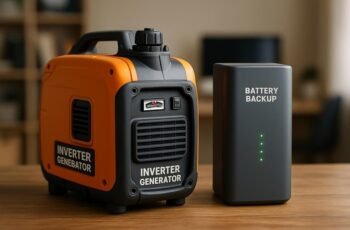
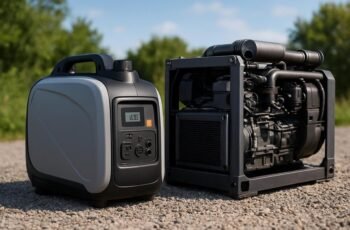
Did you know that inverter generators typically produce between 1,000 and 4,000 watts, while whole house generators can output up to 22,000 watts? This stark difference shapes what each can realistically power, from small electronics to entire household systems. Understanding these capabilities is essential when deciding which generator suits your needs, especially when considering factors like appliance requirements and power stability. Let’s explore how these generators compare in practical use.
Key Takeaways
- Inverter generators power sensitive electronics, small appliances, and medical devices, ideal for portable and recreational use.
- Whole house generators support entire home systems, including HVAC, refrigerators, lighting, and security devices during outages.
- Inverter generators handle loads up to 4,000 watts, suitable for limited power needs and outdoor activities.
- Whole house generators deliver 7,000 to 22,000 watts, managing high surge currents from large appliances and essential home infrastructure.
- Proper sizing is crucial for both types to avoid overloads and ensure continuous, reliable power supply.
What Are Inverter Generators and How Do They Work?
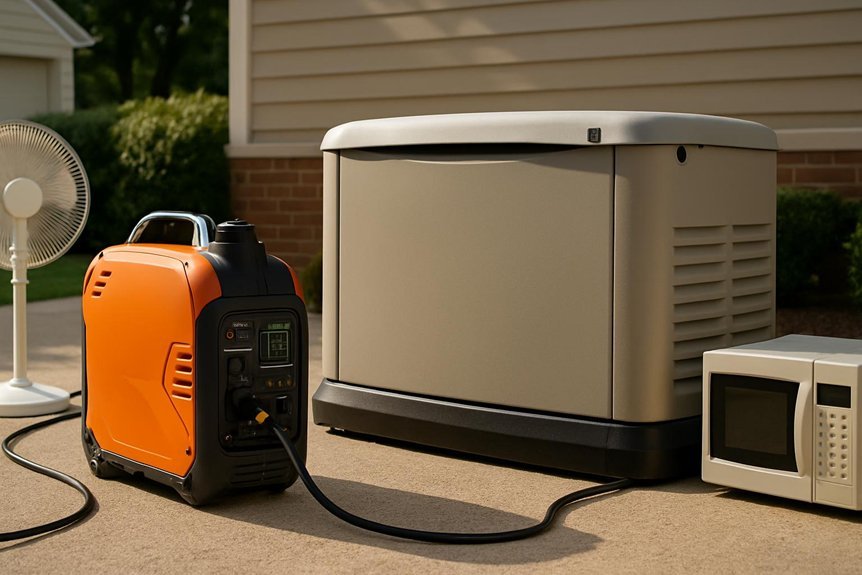
Inverter generators are compact, efficient power sources designed to provide stable electricity by converting raw power into clean, usable energy. Using advanced inverter technology, they first produce AC power, then convert it to DC, and finally invert it back to a consistent AC output. This multi-step process allows for precise voltage and frequency control, resulting in cleaner power ideal for sensitive electronics. Their integrated power management systems optimize fuel consumption by adjusting engine speed according to load demand, enhancing efficiency and reducing noise. Unlike conventional generators, inverter generators deliver a steady sine wave output, preventing voltage fluctuations that could harm devices. Understanding this technology helps us appreciate why inverter generators excel in portability, quiet operation, and power quality, making them suitable for a variety of modern applications.
What Are Whole House Generators and How Are They Different?
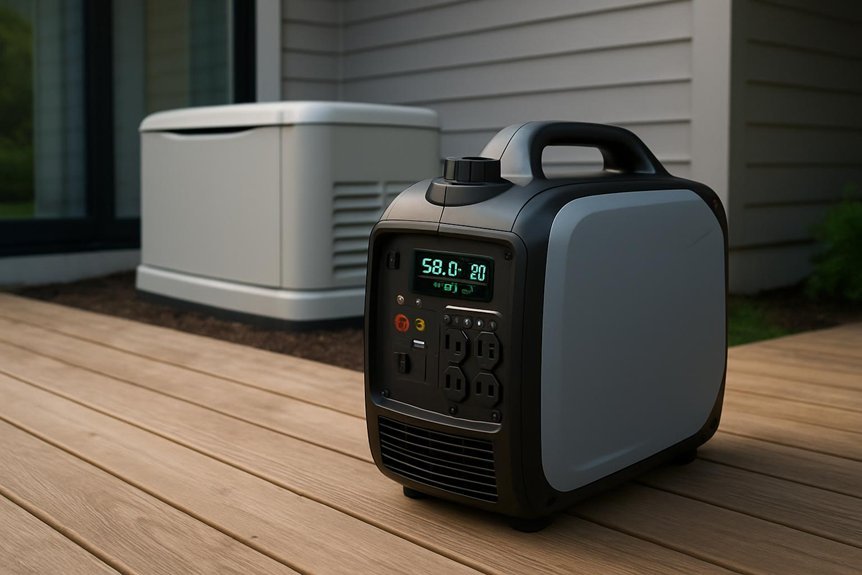
Whole house generators are designed to power an entire home during outages, offering considerably higher capacity compared to inverter generators. They require professional installation and regular maintenance to guarantee reliable operation. Let’s analyze how these factors differentiate them technically and functionally.
Definition And Purpose
Generators designed to power an entire home serve as reliable backups during power outages by automatically supplying electricity to all essential circuits. Whole house generators are stationary units connected directly to a home’s electrical system and fueled by natural gas, propane, or diesel. Unlike inverter generators, which are portable and often rely on gasoline, whole house generators provide continuous power without manual intervention. Their purpose is to maintain normal household operations seamlessly, supporting HVAC systems, appliances, lighting, and more. By understanding different generator types and their associated power sources, we can appreciate how whole house generators prioritize thorough coverage and automatic activation. This guarantees that critical systems remain functional regardless of outage duration, distinguishing them clearly from smaller, portable alternatives.
Power Capacity Comparison
When comparing backup power solutions, understanding capacity differences is essential. Whole house generators offer considerably higher power output and generally have better efficiency ratings than inverter generators. They’re designed to handle entire home loads, powering multiple appliances simultaneously. Inverter generators excel in portability and fuel efficiency but have limited power output, suitable for smaller tasks or essential devices.
| Generator Type | Typical Power Output (Watts) | Efficiency Ratings (%) |
|---|---|---|
| Inverter Generator | 1,000 – 4,000 | 30 – 40 |
| Whole House Generator | 7,000 – 22,000 | 40 – 50 |
| Hybrid Systems | 5,000 – 10,000 | 35 – 45 |
This comparison highlights how whole house generators support extensive power needs, while inverter models focus on efficiency and portability.
Installation And Maintenance
Understanding the power capacity differences sets the stage for examining how installation and maintenance requirements vary between inverter and whole house generators. The installation process for whole house generators is more complex, often requiring professional electrical and plumbing work to connect to your home’s transfer switch and fuel supply. In contrast, inverter generators typically have a straightforward setup, making them more portable and user-friendly.
When it comes to maintenance tips, whole house generators demand regular inspections, oil changes, and fuel system checks to guarantee reliability during outages. Inverter generators require less frequent maintenance but still benefit from routine oil changes and air filter cleaning. By understanding these differences, we can better evaluate which generator suits our needs regarding installation complexity and ongoing upkeep.
How Much Power Can Inverter Generators Provide?
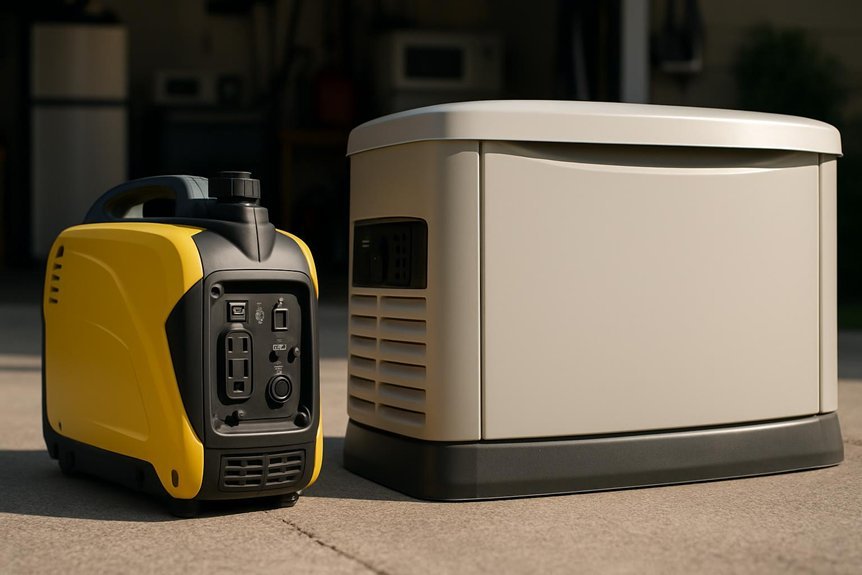
A typical inverter generator delivers between 1,000 and 4,000 watts of power, depending on the model and size. This power output range suits small to medium electrical loads, such as appliances, power tools, and electronics. Generator sizes vary to meet different needs, with smaller units ideal for camping or light backup, while larger inverter generators can support several essential household devices simultaneously. The inverter technology guarantees clean, stable power output, making these generators suitable for sensitive electronics. However, their maximum wattage limits restrict them from handling high-demand systems or entire home loads. By understanding the power output capabilities across generator sizes, we can realistically gauge which applications an inverter generator can efficiently support without risking overload or damage to connected equipment.
What Electrical Loads Can Whole House Generators Support?
Many whole house generators can power nearly every electrical load in a typical home, from essential appliances like refrigerators and HVAC systems to lighting and entertainment devices. When analyzing what electrical loads a whole house generator can support, understanding load types is critical—resistive, inductive, and motor loads each demand different starting and running wattages. Proper generator sizing guarantees these diverse load types are adequately covered, preventing overloads and maintaining stable power delivery. Whole house generators are designed to handle high surge currents from motors in appliances like air conditioners and well pumps. By accurately evaluating your home’s total load requirements, including simultaneous peak demands, we can select a generator that reliably powers your entire household without interruptions, ensuring comfort and safety during outages.
What Appliances Can You Run on an Inverter Generator?
While whole house generators manage high loads across an entire residence, inverter generators focus on smaller, specific electrical demands with greater efficiency and portability. They excel in recreational use and maintain low noise levels, making them ideal for outdoor activities and backup for essential devices. Typically, inverter generators can power:
- Laptops and mobile devices – supporting remote work and communication.
- Small kitchen appliances – like microwaves and coffee makers.
- LED lighting and fans – maintaining comfort without excessive power draw.
- Medical equipment – such as CPAP machines that require stable power.
Their ability to deliver clean sine wave power guarantees sensitive electronics run safely. While not designed for entire homes, these generators offer precise, quiet solutions for targeted power needs during outages or outdoor events.
Which Home Systems Can Whole House Generators Keep Running?
Let’s examine which home systems whole house generators can reliably power during an outage. They handle essential appliances like refrigerators and water heaters, maintain HVAC systems for climate control, and support security and communication devices. Understanding this capacity helps us evaluate their true value for uninterrupted home functionality.
Essential Appliances Supported
Whole house generators provide the capacity to power critical home systems during outages, guaranteeing we maintain comfort, safety, and functionality. Understanding which essential appliances they support depends on analyzing their power requirements and the generator’s output capacity.
Here are four key essential appliances whole house generators can reliably power:
- Refrigeration Units – Maintain food safety by running standard refrigerators and freezers with moderate power needs.
- Water Pumps – Secure continuous water supply in homes with well systems or booster pumps.
- Lighting Circuits – Keep interior and exterior lighting operational for security and usability.
- Communication Systems – Support routers, modems, and charging devices to maintain connectivity.
HVAC And Climate Control
Because climate control systems often demand significant power, we need to carefully evaluate which HVAC components a whole house generator can sustain during outages. Whole house generators are designed to handle high loads, so they can typically power central air conditioners, heat pumps, and furnaces without compromising HVAC efficiency. However, the exact capacity depends on the generator’s wattage and the HVAC system’s startup surge requirements. Maintaining climate control during outages not only guarantees comfort but also protects indoor air quality and prevents system damage from frequent cycling. By sizing the generator appropriately, we can run thermostats, humidifiers, and ventilation fans seamlessly. Ultimately, whole house generators offer extensive support for critical HVAC components, enabling continuous climate control and preserving home livability through extended power interruptions.
Security And Communication Systems
How do we guarantee that our home’s security and communication systems remain operational during power outages? Whole house generators provide continuous power, ensuring critical systems stay active without interruption. Unlike inverter generators that may struggle with sustained loads, whole house generators support:
- Security systems including alarms, surveillance cameras, and motion sensors.
- Communication systems such as landline phones, routers, and modems.
- Backup for smart home hubs that rely on continuous connectivity.
- Integration with monitoring services that alert homeowners or authorities.
Fuel Efficiency and Runtime: Inverter vs Whole House Generators
When comparing fuel efficiency and runtime, inverter generators typically outperform whole house generators in scenarios that demand variable power loads. Their ability to modulate engine speed to match energy requirements results in markedly improved fuel efficiency, reducing consumption during low-demand periods. In contrast, whole house generators run at a constant speed regardless of load, which leads to less efficient fuel use. In a runtime comparison, inverter generators often operate longer on the same fuel volume, making them ideal for extended use in off-grid or emergency situations. Whole house generators excel when powering large loads continuously but consume more fuel over time. Understanding these distinctions helps us choose the right generator based on operational needs and fuel economy priorities, ensuring peak performance and cost-effectiveness.
Portability and Installation Differences Between the Two Generators
Fuel efficiency and runtime are essential factors, but they only paint part of the picture when selecting a generator. Portability features and installation requirements greatly influence usability and setup. Inverter generators excel in portability, often weighing less and including handles or wheels for easy transport. Whole house generators, however, demand permanent installation and professional setup due to their size and connection to home electrical systems.
Portability and installation needs are crucial factors beyond fuel efficiency when choosing the right generator.
Key differences include:
- Portability features: Inverter generators are compact and lightweight; whole house units are stationary.
- Installation requirements: Inverter models need minimal setup; whole house generators require complex wiring and permits.
- Mobility: Inverter generators support temporary use in various locations; whole house generators are fixed.
- Setup time: Inverter generators work immediately; whole house systems need professional commissioning.
Understanding these distinctions helps us assess which generator fits our lifestyle and needs.
How to Choose the Right Generator Based on Your Power Needs
What power demands do we really need to meet during an outage? To choose the right generator, we begin with accurate generator sizing, evaluating essential appliances and systems like refrigeration, heating, and lighting. Overestimating leads to unnecessary cost and inefficiency, while underestimating risks insufficient power. Inverter generators excel with smaller loads and offer superior energy efficiency, ideal for powering critical devices without wasting fuel. Whole house generators, though less energy-efficient, provide broader coverage for multiple high-demand circuits simultaneously. By analyzing our household’s wattage requirements and factoring in surge power for motor-driven appliances, we ascertain ideal selection. This analytical approach balances energy efficiency with capacity, guaranteeing reliable power without overspending. Ultimately, our choice hinges on matching generator sizing precisely to our power needs.
Frequently Asked Questions
Are Inverter Generators Quieter Than Whole House Generators?
Yes, inverter generators typically have lower inverter noise levels and better generator decibel ratings than whole house generators. We can rely on them for quieter operation, especially in noise-sensitive environments or during outdoor activities.
Can Inverter Generators Charge Electric Vehicles?
We can charge electric vehicles with inverter generators, but their limited charging capacity means longer times. Ensuring inverter compatibility is essential for stable power delivery, so we must match generator output to the EV’s charging requirements carefully.
Do Whole House Generators Require Regular Maintenance?
Yes, whole house generators require regular maintenance. We recommend scheduling inspections and oil changes based on maintenance frequency guidelines to guarantee performance reliability, prevent costly repairs, and extend the generator’s lifespan effectively and efficiently.
Are There Safety Concerns Unique to Inverter Generators?
When it comes to safety, inverter generators’ portability advantages and fuel efficiency bring a few unique concerns, like carbon monoxide buildup in enclosed spaces. We’ve got to keep ventilation in mind to avoid any serious risks.
Can Whole House Generators Operate During Severe Weather?
Yes, whole house generators excel in severe weather performance, providing consistent power reliability. We rely on their automatic transfer switches and robust design to maintain uninterrupted electricity during storms, ensuring safety and comfort despite harsh conditions.
Conclusion
When deciding between inverter and whole house generators, it’s clear each serves distinct needs. Inverter generators offer clean, portable power ideal for sensitive electronics and small appliances, while whole house generators provide robust output to keep essential home systems running seamlessly. As the adage goes, “Don’t put all your eggs in one basket”—choosing the right generator depends on balancing power requirements, fuel efficiency, and installation practicalities to guarantee reliable energy where you need it most.